Thursday, February 2, 2017

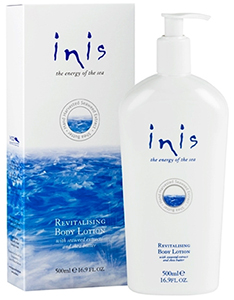
Inis Body Lotion is Now Available in a Pump Bottle at The Irish Gift House!


The widely popular Inis theEnergy of the Sea body lotion is now available in a larger pump bottle at
Inis body lotion pump at The Irish Gift House
TheIrish Gift House.  This revitalizing and nourishing body lotion from The Fragrances of Ireland had been only available in a 200ml tube, but due to strong demand for a larger size container Inis body lotion is now available in a 500ml (16.9 ounce) pump bottle. 

Inis body lotion is unique in that it combines naturally harvested seaweed extracts along with shea butter.  Shea butter is an extract from the African shea tree, and while the butter is eatable, it is mostly used as a moisturizer.  Additional ingredients in this Irish body moisturizer include vitamins and minerals that can nourish your skin and you will be left scented with the cool and seductive fragrance of Inis the Energy of the Sea.

Inis body lotion is perfect for a daily regimen of skin care and is best used immediately after your shower or bath; it is also excellent for use after being in the sun.


Like all the products from The Fragrances of Ireland, Inis body lotion is made in Ireland and is never tested on animals.

The Irish Gift House stocks many different products from The Fragrances of Ireland including their Inis perfume and the Garden of Ireland natural soaps.  In addition to the women's Irish perfume, we also stock Patrick cologne for men.        

Sunday, January 29, 2017

St. Brigid and the St. Brigid's Cross


The short dark days of winter have been getting brighter and longer since the winter solstice marked the shortest day of the year on December 21.  The Celtic calendar denotes February 1 as the pagan festival of Imbolc, the first day of spring, and celebrations are in order to commemorate warmer, longer days and the evidence that new growth is on the way.

February 1 also corresponds with the feast day of St. Brigid, who along with Patrick, is one of Ireland's patron saints.

St. Brigid was born in 451 AD in the town of Faughart in County Louth, Ireland; Faughart honors its native daughter with a shrine and well that regularly receive a substantial amount of tourists and pilgrims.   She was the daughter of Dubhtach, a Leinster pagan chieftain, and Brocca, a Christian slave woman who had been baptized by none other than St. Patrick.  Because her mother was a slave, she too was a slave; however her father notice her works of charity and eventually granted her freedom. 
St. Brigid founded monasteries in Kildare and she is credited with establishing the first order of nuns in Ireland.  Kildare became a center of religion and education and her small monastery eventually evolved into a cathedral city.
St. Brigid is remembered for her great charity and kindness and is second only to St. Patrick, among Ireland’s heritage of saints.  Thousands of Irish woman throughout the world are named Brigid in her honor. 

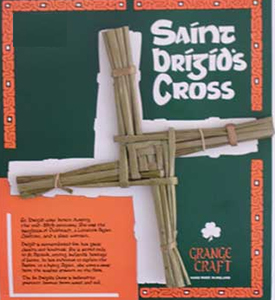
The most enduring image of the Irish saint is the St. Brigid’s Cross.  In her endeavor to explain the

St. Brigid's Cross at The Irish Gift House
Passion of Christ to her father, a dying pagan, she wove a cross from the straw-like rushes strewn on the floor and was able to baptize him just before his death.  In those early Christian times the farmers adopted the custom of making these same crosses at the beginning of spring to protect their holdings, placing the handmade straw cross in prominent positions in their houses and barns.

The tradition of making the crosses on  January 31, the eve of her feast day,  continues to the present day in Ireland and abroad.  The St. Brigid’s Cross is believed to protect the owner from want and evil.


The Irish Gift House is proud to feature a fine selection of St. Brigid's cross necklaces and related jewelry such as charms; this jewelry is made in Ireland by Solvar.  Naturally we also offer many Irish made St. Brigid's wall crosses along with various gifts that include a tankard from Mullingar Pewter and several ornaments.

Wednesday, January 4, 2017

Nollaig na mBean - Women's Christmas!


January 6 is the Feast Day of the Epiphany which marks the end of the twelve days of the Christmas Season.  The season starts with the revelation of Christ to Israel in His birth on Christmas Day and ended with the revelation of Christ to the Gentiles with the visit of the Three Wise Men or Magi at Epiphany.

In Ireland, Epiphany is also known as Nollaig na mBean, which translates from the Irish language to Women's Christmas in English.  On this day women are not responsible for doing any of the housework, taking care of the children or cooking the family meal.  

The women traditionally meet at each other's homes for some relaxation and socializing that includes food and drinks.  The meals would tend to be baked delicacies such as scones and cream cakes, washed down with a nice pot of tea or maybe something a little bit stronger.

The men would stay at home and take down the Christmas decorations, see off the visitors and look
Irish Christmas Decorations at The Irish Gift House
after the house and children.

Ladies, The Irish Gift House hopes that you enjoy your day!

Guinness Gifts at The Irish Gift House


Guinness t-shirt at The Irish Gift House
 

Guinness Christmas Ornament at The Irish Gift HouseThe Irish Gift House is proud to announce that we have just given our Guinness gifts category a complete makeover that includes updated product images and better descriptions.  Naturally we couldn't help adding some new items such the latest Guinness Christmas ornament and a Guinness t-shirt.
Some of the earliest items we ever added to our site, TheIrishGiftHouse.com, were several pieces of Guinness merchandise with one being a Guinness pouring spoon.  These branded pouring spoons will assist you in concocting a black and tan or a half and half; you simply pour the black stuff over the back of the spoon so that it fans out over your ale in the former and your larger in the latter.  You may also wish to use your pouring spoon to create a drink called a black velvet which starts off with champagne.
Irish coat of arms glasses at The Irish Gift House

Most however just order a pint of the plain and your best bet is to use a tulip shaped Guinness glass.  The tulip shaped glass is wider toward the top and the benefit of this shape is to allow the nitrogen bubbles to travel from the bottom and return to the top and create the famous creamy head.  The Irish Gift House offers a varied assortment of 20 ounce Irish beer glasses and Irish coat of arms barware that are perfect way for you to imbibe this ebony nectar from Ireland.  Another classic vessel for enjoying your stout is from one of our Celtic tankards, but don't miss browsing our crystal tankards from Galway Crystal or our pewter tankards from Mullingar Pewter.
Guinness bar sign at The Irish Gift House
The iconic stout has a loyal following and these ardent enthusiasts appreciate Guinness merchandise because they evokes pleasant experiences of drinking Ireland's most famous dark beer.  We have dozens of thoughtful Guinness gifts that you will be pleased to give and receive that range from an apron to several bottle openers.  For the man cave or the home pub we have a selection of Guinness bar signs that include several that are made of wood.

Additional considerations include the Guinness rugby shirts that are woven in a traditional fashion that is suitable for game day and the assortment of Guinness polo shirts are perfect for a round of golf or for casual wear.  

So go ahead and treat yourself to any of our Guinness gifts.  You are encouraged to drink responsibly, but we urge you to browse our site with abandon.    

Monday, October 31, 2016

Halloween's Celtic Roots


The Irish Gift House asks, did you know that Halloween and many of its traditions can be traced back to Ireland?
Samhain, pronounced Sah-ween, is a Celtic festival marking the end of the harvest season and the beginning of winter.  Samhain straddles the time between autumn and winter that coincided with the periods of abundance and shortage.  On the verge of the darker half of the year, Samhain marked the last opportunity for fun, but it was also a time of enhanced superstition.
Halloweens Celtic Roots
The festival starts in the evening of October 31st and continued through November 1st, Samhain indicated three critical dates in the Celtic calendar: the end of the year, the beginning of the year and the start of winter.   The date is roughly between the fall equinox and the winter solstice and Samhain is one of the four Celtic seasonal celebrations, the other three being Imbolc on February 1st, Beltane on May 1st and Lughnasadh on August 1st.  These important dates were traditional observed in Ireland, Scotland, the Isle of Man, and also in parts of Brittany, Cornwall and Wales.
     
Many important actions in ancient Irish tradition happen or begin on Samhain.  It was the time of the year when livestock were brought down from the summer pastures and when animals were slaughtered and stored for the long cold winter.
 
Because Samhain was consider a threshold time the souls of the dead could more easily travel between worlds and invariably they would return to their former homes where they were welcome.  Meals were prepared  and the souls of dead love ones were gestured to attend with a place setting left for them at the table.

A traditional Samhain dish that continues to be served today is colcannon with charms hidden in the  potato and cabbage dish.   The charms that were found in the colcannon were seen as a indication for the future.  For example, a button meant you would remain a bachelor, and a thimble meant you would remain a spinster for the coming year; while a ring meant you would be soon married, and a coin meant you would come into wealth.   Take a look at our New Taste of Ireland cookbook and the simple colcannon recipe.

The ancient Celts would light large bonfires to aid the dead on their way.  The bonfires were also lit as protection from the potentially evil spirits and fairies that were also able to move more freely between this world and the otherworld during Samhain.  Additional rituals related to bonfires included throwing a clipping of your hair into the raging fire and then later while sleeping you would dream of you future love.  Another practice involved ushering the cattle between the fires as a cleansing ceremony after the bones of the previously butchered stock had been thrown into the bonfire.  This fire of bones eventually evolved into our vernacular as bonfire.

Bobbing for apples is another ritual that originated with the fall festival; the implication was the first single person to effectively bite and grab an apple would be the next person to marry.   The consequence may be unknown to today's participants, but bobbing for apples is offered at many Halloween parties.

The earliest Halloween costumes, in the form of hollowed out animal heads, can also be connected to Samhain.  The rational was these scary costumes would protect the human by scaring away the evil spirits that had entered from the otherworld.   Many would leave gifts of food outside their doors in an effort to keep these evil spirits from entering their homes believing that the offerings would be appeasing.   These two combined rituals are partially what evolved into today's trick or treat.
In  an effort to remove many of the pagan rituals from Samhain the Catholic Church in the 9th century changed the date of All Saints' Day to November 1st and added November 2nd as All Soul's Day.  Eventually these three days formed what we know as the modern Halloween, but it wasn't until large numbers of Irish immigrated to the United States in the 1800's that these traditions took hold in this country.
Have a safe Celtic inspired Halloween and please remember that from Irish gifts to Celtic jewelry The Irish Gift House is your one stop Irish shop. 

Friday, October 28, 2016

Celtic Jewelry


The use of Celtic knots and designs in jewelry dates as far back as the 5th century BC as evidenced by torques that have been found by archaeologists.  These ornate torques with their unending lines were worn around the neck of nobles and warriors who believed that energy from the jewelry would be transferred to the wearer and subsequently it would act to ward off evil.   Additionally the suspected vitality of the torque was considered another layer of protection in battle. 
Celtic Bracelets: The Irish Gift House

The ancient Celts believed that the particular metal of the object held significance and related silver to the moon and gold to the sun: those with less affluence and influence has to settle for the more common and relatively accessible bronze or iron for their jewelry construction.          


Book of Kells Jewelry: The Irish Gift House
In due course these torques evolved into Celtic bracelets and the interlaced and uninterrupted lines that decorated the jewelry became more elaborate.   By the time the Book of Kells, a opulently decorated manuscript containing the four Gospels of the New Testament, was written in the 8th century AD, Celtic designs had undergone a brilliant transformation that is demonstrated in the animated illustrations and complex embellishments of the treasured book.   Today you will find these elaborate designs in the Book of Kells jewelry.

  
Dating back 5,000 years to the stone age, Newgrange, a temple with large passage tomb, was built in Co. Meath, Ireland by the local farming community.  Very deliberately, the passage and chamber are aligned with the rising sun at the Winter Solstice thus celebrating the renaissance of the sun after the shortest day of the year.  Many of the megaliths that surround Newgrange are decorated with carved art with the most impressive and recognizable being the entrance stone which is engraved with the tri spiral design that is often found on Newgrange jewelry.   

Many early cultures paid homage to trees and the ancient Celts were no different.  They believed that trees were the foundation of life and that they held mystical powers that represented balance and harmony so it was natural for the symbolism of the tree, often with its supplemental Celtic
Tree of Life Jewelry: The Irish Gift House
knots, to be worn as ornamentation and jewelry.  Today it is common to find the icon as tattoos and as Tree of Life necklaces and earrings.
The monolith Celtic crosses that dot the Irish landscape are some of the most recognizable icons of early Christianity in Ireland.  Many of these monuments, including Cross of Scriptures at Clonmacnoise, are decorated with ornate figure carving and detailed knot work with the principal characteristic being the circle connecting the arms.  As a sign of faith, Christians are often encouraged to wear a cross around their neck so it is very understandable that the Celtic cross necklace would become the symbol of choice for those of Irish and Scottish heritage.


In 1850 a rural woman in Co. Meath, Ireland found an ancient Celtic brooch
Celtic Brooch: The Irish Gift House
that was buried in a sandy beach.  Purely for marketing purposes the brooch was named after the Hill of Tara that is traditionally accepted as the seat of the High Kings of Ireland.  The Tara brooch was made circa 700 AD and illustrates the highly developed craft of goldsmithing in early Ireland.  The much copied Tara brooch now resides at the National Museum and is regarded as one of Ireland's ancient treasures. 

Celtic Wedding Bands: The Irish Gift House
Through their continuous lines the knot and spiral designs in Celtic jewelry symbolizes the wealth and clarity of the ancient Celts.  One of the primary symbolisms of the unending Celtic knot is the representation of endless love so the designs have easily been equated to marriage and thus the popularity of Celtic knot wedding bands 

Celtic Necklaces: The Irish Gift House
The Irish Gift House is proud to offer a full range of jewelry that includes Celtic necklaces and Celtic earrings that is completely made in Ireland.

Sunday, October 2, 2016

Irish Christmas Traditions

Candle in the Window - Irish Christmas TraditionIt seems that the Irish were born to celebrate; just look at St. Patrick's Day, weddings and even wakes for the fun evidence.  Christmas is certainly no different, and while it is a religious season, it is also a time for merriment and festivities that have developed many time honored Irish traditions.

The Candle in the Window:
In the late 16th Century, England imposed Penal Laws in Ireland which effectively outlawed the Catholic Church and the Catholic Mass. The faithful Irish did not think well of these English mandates and a candle was placed in the front window of a home to indicate to others that this was a safe place for priests to perform Mass.

The meaning of the candle in the window, that was traditionally lit by the youngest member of the family, has since evolved into a welcome sign for the Holy Family; it can also represent the love for a family member who cannot be home at Christmas. It is now common to see the front windows of Irish homes lavishly decorated with several electrical candles and lights at Christmas time.  This once exclusively Irish Christmas tradition has now transcended to Christians throughout the world.

Another candle related tradition is the lighting of an Advent wreath.  Advent starts on the fourth Sunday before Christmas and ends on Christmas Eve.  With each ensuing Sunday during the Advent season an additional candle is lit in preparation of Christ's birth; each week has its own theme: hope, peace, joy and love. 

The Irish Gift House features Advent wreaths with Celtic knots; for additional illumination we also have an assortment of light up Irish angel tree toppers too.

Midnight Mass:

Throughout the world, no matter how much they intended to go more often, many Christians go to church only at Christmas; sometimes even the faithful in Ireland fail to go to church every week.  It is an annual tradition on Christmas Eve to attend midnight mass and the Churches in Ireland are full to capacity. For many Irish, the Midnight Mass is a social event shared by friends and family as much as it is religious celebration. Friends will visit with prayer, the singing of Christmas Carols and some good conversation.
Irish Santa at The Irish Gift House
No Milk and Cookies for Santa:
Just before going to bed you will want to leave the traditional Irish treat for Santa Claus.  No it is not milk and cookies but a pint of Guinness and a mince pie. 

By the way, The Irish Gift House has a grand selection of Irish Santa figurines

The Holly Wreath:
For many generations the holly wreath has been traditionally placed on Irish front doors during the Christmas season.  While many in Ireland's past could not afford store bought decoration, even the poorest of the poor could afford to gather the abundant sprigs of holly and every home was decorated with a holly wreath.

In Celtic mythology, the holly was the sacred twin of the oak tree; the deciduous oak was the controller of the sunny summer months while the evergreen holly controlled the dark balance of the year. The Druids believed the holly to own shielding characteristics that offered protection against evil spirits and magical powers.  Celtic lore believed that bringing the leaves of the holly tree inside during the cold months would provide sanctuary from the winter chill for the wee fairy folk, who in return would be generous to those who lived in the home.

Christians have also given the holly tree special reverence as it is believe that holly formed part of the crown of thorns worn at the crucifixion and it was Christ's blood that gave the holly berries their red color.  Christians are also credited for giving the holly tree its name which was derived from the word holy.

Decorating with a wreath on your door is another Irish Christmas tradition that has evolved to become common for Christians throughout the world.
 
Please visit our Irish Christmas Decorations category at theirishgifthouse.com for additional ideas that include several hundred Irish Christmas ornaments and on their own separate page, the Belleek ornaments.  We also have an assortment of Irish Nativity scenes and ornaments along with a collection of Irish nutcrackersThe Irish Gift House is your one stop Irish Christmas shop
Irish Christmas Ornaments at The Irish Gift House