IRISH SUPERSTITIONS
Abiding by the rules of ancient Irish life comes naturally to many who adhere to an unwritten mythical code out of pure habit, automatically reenacting behavioral patterns learned in the childhood years.
WHY ARE THE IRISH SO SUPERSTITIOUS?
Some believe the Irish seem to be consumed by irrational fears and belief because of their history stemming from the history of their Celtic faith. Superstitions are beliefs based on myth, magic, or illogical thoughts, that are not based upon reason and knowledge as much as many reminiscences passed from generations of old. Superstitions are intrinsically tied to traditional folklore, Ireland is a country steeped in legends and myths with a vast array of characters from faeries to changelings, to wily leprechauns.
THE ORIGINS OF SUPERSTITIONS:
The exact origins of many old superstitions do appear to be an odd mixture of paganism, Christianity, and folklore, and deeply influenced by social history. Human nature is such that we always search for a cause for things we cannot understand. That desire to figure things out is the root of all scientific progress, but in the search of answers, rationality didn’t always prevail. When searching for a reason for things beyond their comprehension, imagination, speculation or hearsay would suffice, producing answers steeped in mythical origins.
COINCIDENCE OR ANOTHER FORCE AT WORK?
Sometimes unhappy coincidences reoccurred frequently enough triggering it to be acknowledged, and to become preserved in the general belief system of a community. Irish superstitions are ultimately concerned with addressing the helplessness of the human condition. In times of trouble, and there were plenty such times for the Irish in centuries past, Irish ancestors turned to old superstitions to explain the phenomenon or at most the cause. This blind faith in haphazard cures and beliefs probably brought comfort and hope to those who felt helpless. Whether the warding off of ill luck was real or imagined, at least reassurance was in attempting to control these evils.
ENDURING LEGACY OF SUPERSTITIONS FROM THE TIME OF THE DRUIDS:
Ireland remained under the influence of Druidic teachings far longer than any other European nation. This can be attributed to the island’s remoteness on the western edge of the continent, and its freedom from Roman conquest. When early missionaries converted the Irish to Christianity they did so with minimal conflict without persecutions, adopting a creed of tolerance for the old way of life. Rather than destroying sites of ancient worship, the new church transformed them into shrines of prayer and centers of worship by associating them with a saint. This policy of tolerance for old Druidic superstitions may account for their survival. The Irish have clung to the ancient customs of their forefathers for thousands of years. An enduring belief in a fairy race may be traced back to the time of the druids.
Some Irish superstitions
The ultimate bad luck is to spill your salt and must be countered by throwing a pinch over your left shoulder blinding the demon behind you. For thousands of years, salt has been an object of magic and superstition. Leonardo Da Vinci’s painting of the Last Supper shows Judas knocking over the salt - a harbinger of his betrayal.
Superstitious or not, almost everyone takes note when it’s Friday the 13th. A common theory as to why the Irish have a fascination with this date is that there were 13 people at the Last Supper and Christ died on Good Friday, hence Friday the 13th.
• If you trip and fall in a graveyard you will most likely die by the end of the year.
• A black cat crossing your path is very bad luck. To counteract this make a triangle shape using your thumbs and forefingers and spit at the cat through the hole.
• An expectant mother could determine a baby’s sex by tying her wedding ring to a string and holding it above her stomach. If the ring moves in a circle it’s a boy, if it moves back and forth, it’s a girl.
• If you find a horseshoe and nail it to or over the door open end up, it will bring good luck. This will not work if it is bought or a gift.
• If you find a four-leafed clover you will have good luck however, you must always have it with you. You cannot pass it on to another, nor should you show it to anyone.
• If your ear feels hot someone is talking about you.
• If it’s your nose that's itchy you are going to have a fight with the person nearest to you.
• Handing someone a knife is bad luck. Always put it on the table in front of them never in their hand. Wonder who accidently stabbed someone to start this one.
• If your right palm itches, it means you will receive unexpected money. Conversely the left hand signifies you will spend or lose money.
• If you break a mirror, you will have seven years bad luck.
• A response to a sudden unexplained shudder or shivering. 'Someone is walking over your grave.'
• If you get the wishbone on a chicken, hold one end of it and tell somebody else to hold the other end and whoever gets the right side after pulling it apart will get their wish.
• If you find a penny heads up you will be lucky, pick it up but if it is tails up don’t pick it up or you’ll have bad luck.
• If you take the last portion of a food, you would be an old maid or a bachelor.
• A picture falling from a wall foretells a death.
• If you put your clothes on inside out, you should leave them like that. It’s good luck.
• If you drop a knife, it’s the sign of a gentleman visitor. If you drop a fork, you will receive a lady visitor.
• Good luck housewarming gifts include bread so that you will never be hungry; a broom so you will be able to sweep troubles and bad luck away and salt to replace tears, spice up your life and bring good luck.
The Irish Gift House wishes to thank guest blogger Barbara M. for this column.
The Irish Gift House is a family owned and operated on-line gift store that specializes in Irish jewelry, Claddagh rings, Irish gifts and Celtic jewelry that includes Celtic Crosses and Celtic wedding bands.
Friday, March 23, 2018
Friday, March 2, 2018
Top 10 Things NEVER To Do In Ireland
Whenever you’re traveling somewhere new it’s best to become
familiar with a few of the local customs to avoid offending anyone, and Ireland
is no exception. For the most part, the Irish are some of the warmest and
friendliest people you’ll ever meet.
Around 2 million Americans are expected to visit Ireland this year, so with your holiday enjoyment in mind, The Irish Gift House has put together a top 10 list of thing that you should NEVER do during your visit.
Traditionally in
the US, St. Patrick’s Day is celebrated by enjoying a hearty meal of corned
beef and cabbage. Not likely you’re going to find it on any menu in Ireland. It
is an American creation, and many mistakenly believe it is the national dish of
Ireland. As a matter of fact the cuisine in many pubs is more continental
imagine linguini and white clam sauce offered in many places. If you do find it
on a menu, you can be sure it’s a restaurant that caters to tourists.
2. Don't Use a Phony Irish Accent
Some travelers
think that when they’re visiting European countries, they should try to employ
the local colloquialisms. Trying to emulate the Irish accent is not advised.
Locals dislike it when foreigners attempt to speak like them, so please refrain
from saying “Erin go bragh” when you visit. But if a local says “Top o’ the
mornin’ to ya”, you might get along with the reply “and the rest of the day to
yourself” or not. So please don’t
greet anyone with the phrase “top of the morning...” Rarely if at all does an
Irishman ever use cliché Irish movie phrases. They’re considered stereotypical and
you’ll sure to be viewed unfavorably amongst the locals.
3. Don't Order an “Irish Car Bomb”
Never order an Irish Car Bomb while
in Ireland (or from an Irish bartender). Though the shot-and-beer combo doesn't
mean to offend (it only means to get you
tipsy), its name is a rather insensitive reference to a dark era in
Ireland's history. If you're craving the sweet, malty party drink, try making
one when you go home...Stick with the Guinness, Jameson whiskey or Irish
coffee. And don’t look for green beer that too is an American brainchild. Yes, this drink of Guinness stout, Bailey’s Irish Cream
and Jameson Irish Whiskey is popular in America. This order will bring up old
wounds and will most likely get you kicked out of the pub. The name originates
from the many car bombings that took place during the Troubles in Ireland. It
is also recommend that you don’t ask for a “Black & Tan” either. You’ll be
asking for trouble.
4. Don't Talk About Leprechauns
Tourists traveling
to the Emerald Isle often find it amusing to ask the locals about leprechauns,
as if these legendary little folk were real and commonplace. However, Irish
citizens find it more tiresome than funny. So next time you’re traveling to
Ireland, don’t crack any jokes about leprechauns, pots of gold or rainbows with
the locals.
5. Don’t ‘Just’ Visit Dublin
Ireland’s capital city is great place to visit. There’s the
Guinness factory, Temple Bar, Waterford Crystal factory and some beautiful
shops and churches to discover. But the lush green countryside is surely
Ireland’s prized possession. You’ll definitely want to explore rural areas,
other cities and landmarks such as Galway, Belfast, Killarney National Park and
Killarney lakes featuring graceful swans aplenty, Doolin and the Cliffs of Moher,
Dingle and the famous fun loving dolphin Fungie.
6. Don't Talk About American Politics
Like many
Europeans, the majority of Irish citizens would be considered either Democratic
or Liberal, so don’t plan on discussing conservative politics, Trump or any hot
topics with any of the locals. Likewise spouting Liberal support can land you
in deep trouble with a few locals. Better to just enjoy your trip and
appreciate Irish charm and friendly fun loving people.
7. Don't Compare Ireland to Home
Many visitors love
to compare Ireland to their native country. This is kind of rude, and locals
find it very irritating to constantly hear how things like food, culture,
trends and customs compare to your America. So avoid making remarks about the
things that are different and enjoy Ireland for what it is – a beautifully
authentic country.
8. Don't Brag That You’re All Irish
Even if both sides
of your family come from Ireland, don’t plan on bragging about being 100% Irish
to any locals. Because the Irish people consider themselves 100% Irish and if
you’re visiting from the America, you would merely be considered an
Irish-American. Don’t even debate it either, as you definitely won’t make
friends. If you mention which part of Ireland your family came from, locals may
be willing to discuss your heritage. And you well know what they say about
braggarts… nobody like them.
9. Don't Stereotype
Don’t expect everyone to have red hair and freckles, and if you visit the Emerald Isle this St Patrick’s Day don’t expect a sea of green garb! Many Americans wear green on St Patrick’s Day known by many as the ‘wearing of the green’ to celebrate their Irish heritage. In Ireland people wear a small bunch of shamrocks on their right breast rather than wear green clothing to signify their Irishness and its traditional connection with St Patrick. The shamrocks are blessed at Church ceremonies all over Ireland by either the local priests or bishops, this is known as Blessing of the Shamrock.
10. Don’t Expect Pubs to be All-nighters.
One misconception about Ireland is that people stay up all night drinking at local pubs. Most pubs in Ireland close at either midnight or 1 am. However if you make friends at the bar or pub, you may be invited home to continue drinking until the wee hours of the morning.
11. Optional Bonus Item: Don't Visit the Blarney Stone
Don’t expect everyone to have red hair and freckles, and if you visit the Emerald Isle this St Patrick’s Day don’t expect a sea of green garb! Many Americans wear green on St Patrick’s Day known by many as the ‘wearing of the green’ to celebrate their Irish heritage. In Ireland people wear a small bunch of shamrocks on their right breast rather than wear green clothing to signify their Irishness and its traditional connection with St Patrick. The shamrocks are blessed at Church ceremonies all over Ireland by either the local priests or bishops, this is known as Blessing of the Shamrock.
10. Don’t Expect Pubs to be All-nighters.
One misconception about Ireland is that people stay up all night drinking at local pubs. Most pubs in Ireland close at either midnight or 1 am. However if you make friends at the bar or pub, you may be invited home to continue drinking until the wee hours of the morning.
11. Optional Bonus Item: Don't Visit the Blarney Stone
If you’re planning
on visiting Ireland you’ve no doubt heard of the Blarney Stone, but some people
recommend that you skip that site. This attraction has become something like
the Disneyland of Ireland, with posed pictures and exorbitant fees and
expensive souvenirs. There are so many more authentic things to do and see in
this country, you may file this as tourist trap under things not to do in
Ireland. But who among us has not been victim to Disneyland’s outrageous costs
and long waits and yet had a wonderful time. I still wear my t-shirt stating "I
kissed the Blarney Stone" and have the picture to prove it. So let’s leave
that it up to you.
So good luck to all the Irish and all those that wish they were.
Monday, February 12, 2018
Shamrock History

What do you know about the shamrock? From the Druids to St. Patrick and British oppression the shamrock is part of Irish history.
During the Iron Age in Ireland, from 500 BC to 400 AD, the ancient Druids believed that the number 3 held mystical powers. This is evident in the stone carvings found at Newgrange in Co. Meath, along with numerous occurrences found in Celtic knot-work, such as the commonly named Trinity knot. The Druids considered the three leaves of the shamrock plant, which blankets the ground in Ireland, to be a natural sign of their scared number 3.
The Druids also believed that the shamrock held medicinal attributes along with mystical powers. One belief is that shamrock, by pointing its leaves upward, could foretell a change in the weather. Then, as it is now, the shamrock was considered lucky; however the Druids believed that it could keep you from harm by warding off evil spirits.
The word shamrock derives from seamair óg that translates to young clover in the Gaelic language and St. Patrick is credited to adding to the popularity of this Irish icon during the 5th century.
St. Patrick, who spent his early life as a slave in Ireland, followed God's command, that he had received in a dream, to escape and return to his home and family in Britain. St. Patrick, who had become very spiritual during his captivity, entered a monastery and became a Catholic Priest. 30 years later, St. Patrick, who by this time had become a bishop, felt the calling to return to Ireland as a missionary to the pagan Irish.
According to legend it was during this time that St. Patrick used the symbolism of the 3 leaf shamrock to explain the concept of the Holy Trinity; the Divinity of God the Father, God the Son and God the Holy Spirit are like the 3 leaves of the shamrock, three in one.
March 17th, the day of St. Patrick's death, is celebrated as both a religious holiday and as a celebratory event. In tribute to Ireland's patron saint a shamrock is traditionally worn on this day and many participate in the custom of drowning the shamrock by placing the shamrock in the last glass of whiskey or beer of the night and then when the drink is finished the shamrock would be plucked out of the glass and tossed over the left shoulder for luck.
The British infamously receive credit for endearing the status of the shamrock because during the 19th century reign of Queen Victoria wearing the Irish icon was outlawed and even punishable by death. Naturally, the shamrock became a symbol of Irish rebellion and the wearin' of the green became a point of national pride.
Today the shamrock is Ireland's most recognizable symbol and Irish throughout the world wear them with glorious pride.
The Irish Gift House is proud to offer a collection of Irish made shamrock jewelry and we would be honored if you were to browse our assortment.
Thursday, January 4, 2018
Claddagh Ring - Perfect Valentine's Day Gift
St. Valentine's Day is rapidly approaching so we will let
you in on a little secret. More Claddagh rings are given on February 14th than on any other day of the year. The
reason is because those in love, along with those hopeful of love, know that a
Claddagh ring is the perfect Valentine's Day gift.
This iconic Irish ring made its first appearance in 16th
century Ireland when a fisherman by the name of Richard Joyce was captured and enslaved. During his captivity he fashioned a unique ring for the girl he
left behind in their beloved town of Claddagh in the west of Galway. Eventually
Joyce escaped and returned to his love; he gave her the ring and they lived
happily ever after.
The Claddagh ring history alone qualifies the design as a gift
of affection, but there is so much more to our story. There are three elements
to a Claddagh ring; the heart in the center that symbolizes love, the crown
above the heart that symbolizes loyalty and the hands cradling the heart that
symbolizes friendship. These three ingredients
are combined in a recipe for romance.
Another focal point of a Claddagh ring is known as the Galway
Folklore which relates to how the ring is worn. Sure it is worn on a finger, but the location
along with the direction of the ring, indicates if your heart is taken or not.
When a Claddagh ring is worn on the right hand with the heart closest to your heart a special comment to someone is indicated; however, when worn on the right hand with the heart outward it is an indication that your heart is yet unoccupied.
A Claddagh worn on the ring finger of the left hand with its heart closest to your heart is
worn as a Claddagh wedding ring; however, it should be considered a Claddagh engagement ring when worn on the same finger with the heart away from your
heart.
According to the legend, the first design was a gold Claddagh ring, but sterling silver Claddagh rings are also extremely popular and any would make an exceptional St.
Valentine's Day gift.
Ladies may also give one of these unique Irish designs to
the special guy in their life as there is a abundant selection of men'sCladdagh rings that includes several masculine styles that feature Celtic knot-work.
One last thought to make your Valentine's Day gift truly
special; make sure that your ring is crafted in Ireland. Every Claddagh ring
from The Irish Gift House is made in Ireland and has been hallmarked by the
Irish Assay Office that is located at Dublin Castle.
Sunday, November 5, 2017
Irish Peat, a Source of Heat, Energy and Gifts.
In Ireland, peat, which is also commonly called turf once it
has been cut, is harvested from the bogs as a source of fuel; this practice has
been an integral part of Irish history for centuries and continues today.Peat is an accumulation of partially decayed vegetation that is cut from the land. Traditionally, turf was hand cut with a sharp hoe that produced thick, muddy bricks that were stacked during the summer months to dry.
Until the 20th century, peat's principal uses as an alternative to wood were heat along with fuel for cooking. Peat continues to be used for heat and cooking in homes and business throughout Ireland; however, typically the milled peat is dried and compressed into briquettes.
In modern times the peat is scraped with heavy equipment as
part of an industrialized process with much of the peat fired at electric
generating stations. The Irish government established Bord na Móna as the agency
that oversees the peat resources for the economic benefit of Ireland.
For centuries peat or turf has been an integral part of
Irish history with the boglands possessing a rugged beauty that has inspired
generations. Turf is a wonderful and unique product of the land that has
evolved into a fine medium of artistic expression that enriches the links of
our Celtic heritage and cultural identity.
The Irish Gift House is proud to offer a collection of
carved ornaments and figurines that we have assembled in our new Irish peat gifts section.
Monday, October 16, 2017
Arizona Law Enforcement Emerald Society Shamrock Patch - The Green Backs the Blue
The Arizona Law Enforcement Emerald
Society (ALEES) shamrock
patch is back in stock at The
Irish Gift House. 100% of the
proceeds benefit the benevolent works of ALEES which includes assisting the
families of fallen officers and first responders.
The ALEES patch features an embroidered earth tone design of
the Arizona flag inside of a shamrock. This Irish patch measures 3" wide x
1 3/4" tall and it is two piece military or tactical style design with a
Velcro backing. This shamrock patch will look great on caps or clothing along
with backpacks and you will be assisting ALEES help the families of fallen
first responders in both Arizona and throughout the United States.
The ALEES shamrock patch is available from The Irish Gift House for only $6.95 each or for a limited time you may receive one free of charge with any purchase of $99.00 or more. Either way, $6.95 is donated to ALEES for every patch shipped. Additionally, each patch is complete with a shamrock history card that is complements of The Irish Gift House.
The ALEES patch is a hot item that is now in its second
production run. Through your generosity, The Irish Gift House has raised over
$700.00 for ALEES since this promotion started in September, 2017. Through our
special promotions and your assistance, The Irish Gift House has donated almost
$37,000.00 to ALEES during the past decade. On the ALEES' Facebook page they
write, While you are there, give them a good review, they've been backing the
blue before it was popular.
Arizona Law Enforcement Emerald Society is compromised of
Law Enforcement professionals, active and retired, throughout the great State
of Arizona. They are part of a nationwide fraternal institution created over 60
years ago to promote a social spirit among police officers of Irish ancestry
and those with an Irish spirit.
ALEES has evolved into a benevolent organization which,
through its Non-Profit Foundation provides immediate financial support to
families of law enforcement officers who are killed or seriously injured in the
line-of-duty while serving.
The Irish Gift House is a mom and pop Irish gift site that
is based in Arizona and boasts the largest collection of Irish and Celtic gifts
and jewelry in the world.
Saturday, September 2, 2017
Labor Day's Irish Roots
Irish immigration to the United States during the 19th Century is counted in
the millions; with a huge concentration arriving during the Great Irish Famine
of 1845 through 1852. In Ireland they were starving to death, but in the United
States, along with other unskilled immigrant laborers, the Irish were working
to death.
There was no shortage of work in our young country for the Irish immigrant and their progeny. Railroad and canals along with growing skylines were being built a rapid pace, and the mills factories and mines also ran on cheap and easily replaced labor.
The laborers toiled long hours, often 12 hours per day and seven days a week, just to earn the most basic living. The work was performed in often dangerous and unsanitary conditions. These conditions, along with child labor and low wages, contributed to the organization of labor unions. Many of the early leaders where Irish immigrants along with their adult children.
The industrialists of the day when to great length to halt the organization of the workers. Violence and death was a common practice as was the case of the Pullman Strike of 1894 that resulted in the deaths of 30 strikers. The strike was crushed and the demands were not meet, but industry was definitely on notice. Additionally, six days after the strike ended, congress, in an effort to appease organized labor, designated Labor Day as a federal holiday, a concept that was initiated by two men whose parents were Irish immigrants.
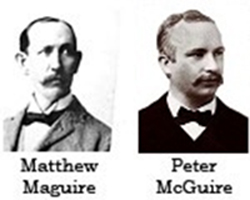
It is known that Peter McGuire, proposed a workingman's holiday during a meeting of the United Brotherhood of Carpenters and Joiners. McGuire was the organization's general secretary at the time and he later went on to be a co-founder of the American Federation of Labor (AFL).
A case is also made claiming that it was Matthew Maguire, a machinist and union leader, who proposed a Labor Day holiday to the Central Labor Union in New Jersey. Maguire went on to be selected as the 1896 nominee for vice president for the Socialist Labor Party of America.
Samuel Gompers, who co-founded the AFL along with Peter McGuire, credits his partner as the father of Labor Day. It is widely speculated that Gompers did not want the credit to go to Matthew Maguire, who was an avowed socialist, because many in organized labor wanted to distance the movement from socialism.
Regardless of which of these two Irishmen is the actual father of Labor Day, it is definite that both men were involved in establishing the Labor Day holiday. The Irish Gift House hopes that you enjoy your three day weekend.
There was no shortage of work in our young country for the Irish immigrant and their progeny. Railroad and canals along with growing skylines were being built a rapid pace, and the mills factories and mines also ran on cheap and easily replaced labor.
The laborers toiled long hours, often 12 hours per day and seven days a week, just to earn the most basic living. The work was performed in often dangerous and unsanitary conditions. These conditions, along with child labor and low wages, contributed to the organization of labor unions. Many of the early leaders where Irish immigrants along with their adult children.
The industrialists of the day when to great length to halt the organization of the workers. Violence and death was a common practice as was the case of the Pullman Strike of 1894 that resulted in the deaths of 30 strikers. The strike was crushed and the demands were not meet, but industry was definitely on notice. Additionally, six days after the strike ended, congress, in an effort to appease organized labor, designated Labor Day as a federal holiday, a concept that was initiated by two men whose parents were Irish immigrants.
It is known that Peter McGuire, proposed a workingman's holiday during a meeting of the United Brotherhood of Carpenters and Joiners. McGuire was the organization's general secretary at the time and he later went on to be a co-founder of the American Federation of Labor (AFL).
A case is also made claiming that it was Matthew Maguire, a machinist and union leader, who proposed a Labor Day holiday to the Central Labor Union in New Jersey. Maguire went on to be selected as the 1896 nominee for vice president for the Socialist Labor Party of America.
Samuel Gompers, who co-founded the AFL along with Peter McGuire, credits his partner as the father of Labor Day. It is widely speculated that Gompers did not want the credit to go to Matthew Maguire, who was an avowed socialist, because many in organized labor wanted to distance the movement from socialism.
Regardless of which of these two Irishmen is the actual father of Labor Day, it is definite that both men were involved in establishing the Labor Day holiday. The Irish Gift House hopes that you enjoy your three day weekend.
Subscribe to:
Posts (Atom)